
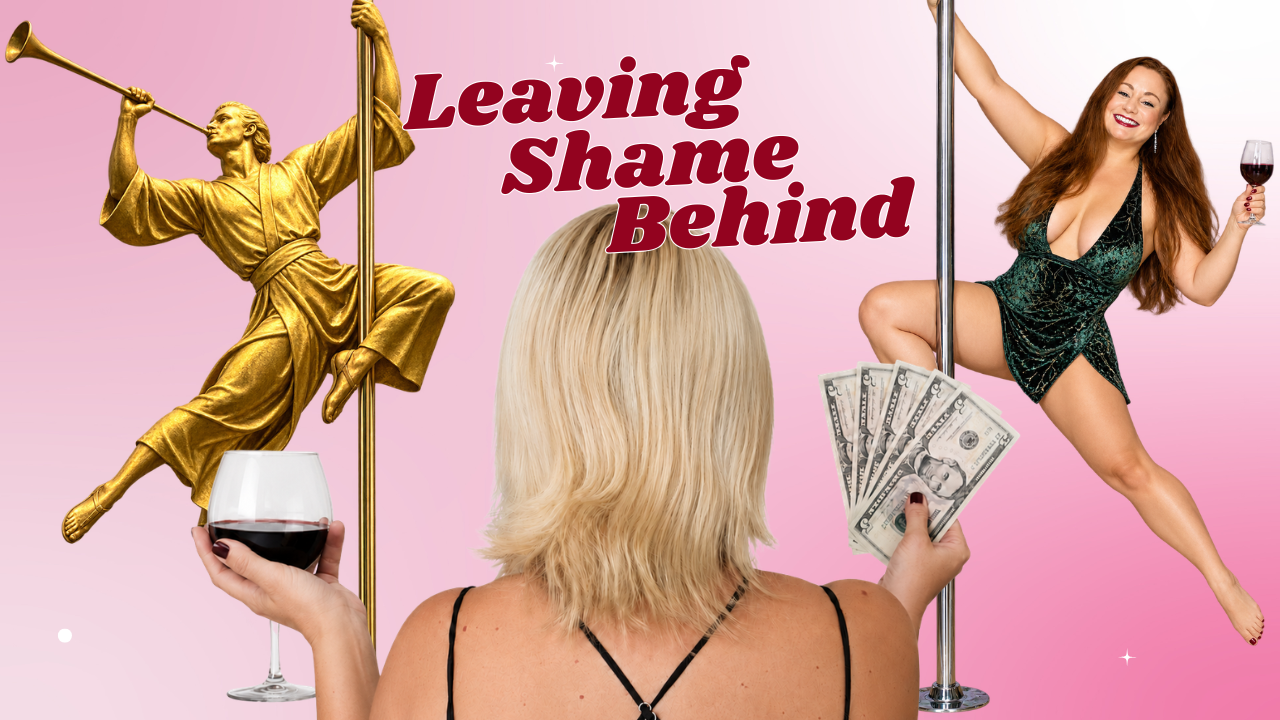

Two ex-Mormons with provocative careers talk about being raised in the religion and finding their way to spicier, more fulfilling lives in sex-related industries.
Watch on YouTube here:
And listen on Spotify here:
There is something deliciously mischievous about calling yourself a Mormon girl gone bad.
Elayna Love and I were both raised in devout Mormon environments. Today, I host a podcast about sex, relationships, pleasure, and all sorts of things that would have scandalized the people who raised me. Elayna is an exotic dancer and adult content creator who openly talks about sexuality and recovering from purity culture. We met through the post-religious sexuality community and immediately recognized something familiar in each other.
But our conversation on Sex and the Solo Girl was not really about becoming “bad.”
It was about what happens when women who were taught that goodness meant obedience begin deciding for themselves what goodness, sexuality, relationships, pleasure, and freedom actually mean.
And that is where Mormon Girls Gone Bad gets much more interesting.
Key Takeaways
- Leaving Mormonism does not necessarily mean that its teachings immediately leave you.
- Mormon purity culture can affect how women understand desire, sexuality, shame, and their own bodies.
- Being given strict rules is very different from learning how to identify and communicate your own boundaries.
- Sexual shame can linger even after you intellectually reject the beliefs that created it.
- Sexual freedom does not require abandoning values. It can mean developing values based on consent, communication, choice, and care.
- Life after Mormonism can include discovering ambitions, relationships, identities, and desires that were never part of the life you were originally told to want.
- Reclaiming sexuality is ultimately less about being “naughty” and more about becoming the author of your own life.
Mormon Girls Gone Bad Grew Up in Mormon Purity Culture
To understand why the phrase “gone bad” is funny to us, you first have to understand what counted as bad.
Elayna and I were raised with very specific expectations around sexual behavior. The materials we grew up with prohibited sexual relationships before marriage and warned against masturbation, sexual touching, sexual thoughts, and other forms of sexual expression.
But Mormon purity culture was bigger than a rule saying, “Don’t have sex.”
It shaped the idea of what a good girl was supposed to look like, think about, want, and eventually become. Elayna remembers growing up with the idea that girls simply were not sexual beings. Desire itself could feel dirty
Her family was especially strict. Certain words were forbidden. Movies could be unacceptable because of how a female character dressed. Even Aladdin was off-limits because Jasmine was considered immodest.
My childhood had its own version of this constant monitoring. I remember feeling as though you were always waiting to discover that some perfectly ordinary thing was actually something you could get in trouble for. That kind of environment teaches you to scan constantly for the invisible line you might accidentally cross.
Elanya told me that, as a Mormon girl, becoming a stripper was one of those things she had essentially vowed she would never do because she regarded it as immoral. Years later, she walked into a strip club terrified, curious, and completely inexperienced.
The important part of that story is not that stripping is the proper antidote to Mormonism. It is that Elayna eventually had the chance to examine something she had been taught to condemn and decide what she thought about it.
Learning To Follow Rules Is Not the Same as Learning Boundaries
One of the ideas from our conversation that has stayed with me most is the difference between being taught rules and being taught boundaries.
Elayna explained that exotic dancing actually helped her learn how to set boundaries. That sounds counterintuitive if you grew up believing that sexual environments were inherently dangerous, but it makes sense when you look more closely at the education we received.
We were told what not to do.
We were not necessarily taught how to ask ourselves what we wanted, what we did not want, why we felt comfortable with something, how to communicate a limit, or how to negotiate an intimate situation with another person.
As I put it during our conversation, the church set the boundaries for us.
Learning “Just Say No” vs learning Consent And Sexual Communication
I remember watching an episode of Blossom as a young teenager in which a boyfriend ignores her “no” and becomes physically aggressive. My mother’s response was that Blossom should never have gotten into the car with him. I remember thinking even then that something was wrong with that logic.
The message was not, “Her no should have been respected.” The message was, “She should never have entered the situation to begin with.”
That difference follows people into adulthood.
Elayna now encounters people carrying wounds from purity culture who struggle to tell partners what they want, explore their own desires, or enjoy sexuality without shame.
Healthy sexuality requires much more than avoiding a prohibited list. It requires that you know yourself well enough to make sexual choices intentionally.
That means being able to say yes.
It also means knowing how and when to say no.
Leaving Mormonism Does Not Automatically Make the Shame Disappear
One of the most important parts of my conversation with Elayna was realizing how differently leaving Mormonism affected us.
Elayna’s exit was psychologically brutal. She described panic attacks, night terrors, severe distress, and spending a tremendous amount of time trying to recover from the religion she had left.
I did not experience that same acute reaction myself.
I left relatively young, and many of the things I had been taught to fear quickly became normal parts of the world around me. There is no single emotional template for leaving the Mormon church (or any other religion, for that matter).
Elayna made a particularly useful point: sometimes religious conditioning is obvious, and sometimes it sits quietly in the back of the mind.
She remembers drinking coffee after leaving and having an automatic internal reaction that she was sinning and would be punished. Intellectually, she no longer believed the rule. Her emotional response had not caught up yet.
That is important when talking about sexual shame and religion as well. Changing your beliefs does not always instantly change the feelings that were attached to them.
When Sexuality Becomes Something You Have to Confess
For me, some of the clearest examples come from adolescence.
I had what I now consider a fairly ordinary teenage sexual life: kissing, experimenting, fooling around with a boyfriend. But after doing something sexual, I could become so overwhelmed by guilt that I felt compelled to confess it to my bishop before I could relax again.
Elayna’s experience was different but equally revealing. She described feeling tremendous shame around masturbation, eventually discussing it with church leaders and a therapist. When she wanted to serve a mission, she says she was told that her masturbation represented an addiction she needed to overcome.
Elayna has done extensive personal work around religious trauma and has worked with psychologist Marlene Winell, author of Leaving the Fold.
What I find most useful here is not applying a diagnosis to everyone who grew up religious. It is recognizing that conditioning can survive long after belief changes.
You can stop believing you are doing something wrong and still feel guilty when you do it.
Reclaiming Sexuality Means Learning What You Actually Want
Obviously, you do not have to become a stripper, or practice non-monogamy, or become kinky to reclaim our sexuality. You do not even have to be particularly interested in sex at all. You get to decide what it means to you.
Elayna described sexual liberation as being able to experience pleasure without shame while still grounding sexuality in consent, boundaries, and not harming other people. I think that is a much richer ethical framework than simply dividing human behavior into “allowed” and “forbidden.”
My own reaction to leaving was eventually to become radically open. For a while, I hid coffee makers and beer bottles when my family visited. I even hid the fact that I was living with the man I would later marry. Eventually, I got tired of hiding.
Over time I became increasingly public about my relationships, sexuality, and the life I was building. That openness is part of why Sex and the Solo Girl exists.
I do not think everyone needs to live as publicly as I do. I do however think everyone deserves the opportunity to decide what they want without assuming that an inherited rule is automatically the same thing as a personal value.
Life After Mormonism Can Mean Writing Your Own Map
Sexuality is only part of this conversation.
For Elayna, one of the greatest gifts of her life after Mormonism has been becoming an independent person. She remembers being taught that the highest aspiration for a woman was becoming a wife and mother. That simply was not what she wanted.
She wanted writing, art, performing, teaching, and work that helped people heal. Leaving gave her room to discover that she did not need a man to make decisions for her or serve as the head of her household.
My life after leaving has not always been easy. But I have had a sense of autonomy that I simply did not know existed when I was growing up. I have traveled, built relationships I could never have imagined then, created this podcast, and constructed a life that fits me rather than the person I was told I should become.
Maybe the “Bad Girl” Was the Free Woman All Along
Near the end of our conversation, Elayna laughed that perhaps she is actually a Mormon girl gone good! She described finally being able to experience herself as a human being instead of interpreting her ordinary human desires as evidence that she was fundamentally sinful.
For me, the biggest change has been learning to identify my own desires and then move toward them.
I call it living a desire-led life.
And desire, here, means much more than sex. It means asking what kind of relationships I want. What kind of work I want. What gives me pleasure. What I believe. What I value. What I want my life to look like while I am actually here living it.
I think that’s the real story behind Mormon Girls Gone Bad. Two women stopped following a map someone else handed them and started drawing their own. And if that counts as bad, I am quite comfortable staying naughty.
Listen to Mormon Girls Gone Bad on Sex and the Solo Girl
Listen to the full “Mormon Girls Gone Bad” episode of Sex and the Solo Girl for my complete conversation with Elayna Love about Mormon purity culture, sexuality, leaving religion, shame, boundaries, and the freedom we found afterward.
You can also explore Elayna’s work at ElaynaLove.com and through her social channels, where she talks openly about sexuality, adult entertainment, and recovering from purity culture. She describes expanding her work in this area as more people reach out to her with questions about their own experiences.
And if conversations about sexuality, relationships, pleasure, and figuring out what you actually want sound like your kind of thing, subscribe to Sex and the Solo Girl and join me for more candid conversations about living a life that belongs to you.
WAIT! Go show Elayna Love some podcast love! Follow her:
Elaynalove.com: http://Elaynalove.com
Facebook: https://www.facebook.com/ElaynaLovexXx
Instagram: @elaynalove: https://www.instagram.com/elaynalove/
TikTok: @elaynalovexoxo: https://www.tiktok.com/@elaynalovexoxo
YouTube: @elaynaloveclub: https://www.youtube.com/@elaynaloveclub
🍷🍷Want to buy me a glass of wine? Head to my Patreon here. 🍷
Resources mentioned in this episode:
Divorcing Religion with Janice Selbie.
Leaving the Fold by Marlene Winell.



0 Comments